Colossus 1: xAI’s Ambitious 500 MW Energy Deployment

Ana Valencia

Energy Strategy: Scaling Under Power Constraints
From the beginning, Colossus 1 was designed to scale faster than the local grid could immediately support. To do this, xAI relied on a mixed power strategy, enabling the deployment of large scale computing capacity.
Aterio datasets
See the data behind the story
The records behind this article live in the US Data Center Locations and Power Demand dataset.
In early operations, mobile natural gas generators were used, allowing the campus to run while grid upgrades were still under construction. During this phase, multiple turbines were operating before formal air permits were issued, a situation later documented through local reporting and public records. As grid access expanded, the first major substation connection came online, and large scale battery storage was added to support system reliability during outages and load changes.
Together, these measures allowed Colossus 1 to increase available power in stages rather than waiting for full grid build out.
Timeline of Energy Expansion
July 2024
The supercluster was activated after 122 days of construction. The grid supply to the site was limited to roughly 8 MW, so xAI added 14 Voltagrid gas generators totaling approximately 35 MW, bringing estimated available capacity to about 43 MW. Also, an undisclosed number of Tesla Megapack batteries were set up to stabilize the power system.
August 2024
Memphis Light, Gas and Water (MLGW) began supplying up to 50 MW of grid power. Four larger Solar SMT-130 turbines were installed alongside the existing mobile units, raising estimated available capacity to roughly 149 MW, although several turbines lacked formal permits at this stage.
With the increase in energy capacity, the installation pace also reached new levels, with the plugging in and activation of 25,000 GPUs every week.
April 2025
Site inspections and reports indicated up to 35 gas turbines with a combined capacity of approximately 422 MW, yet many were not authorized to operate. The Shelby County Board of Commissioners held a meeting where multiple Memphis residents voiced their concerns about the lack of regulation regarding the use of these generators.
May 2025
Connection to Substation #63 increased grid supply to 150 MW and at the same time, 150 MW of battery storage was integrated. Roughly half of the on-site generators were removed, bringing estimated available capacity to approximately 360 MW, depending on which turbines remained operational.
July 2025
The Shelby County Health Department issued an air permit authorizing 15 Solar SMT-130 turbines with a combined capacity of 247 MW, including emissions limits and restrictions on startup and shutdown events. Failure to comply with the conditions established in the permit could result in $10,000 fines.
September 2025
Most turbines located near the substations were removed. Based on site observations, only 12 gas turbines remained installed, despite the air permit authorizing up to 15 units. This placed estimated available capacity near 350 MW when combined with grid supply.
January 2026
As of today, Colossus 1 has an installed capacity exceeding 300 MW, supplied through a combination of grid power and now permitted on-site turbines. The site currently receives 150 MW from MGLW, with the remainder coming from gas generation. Construction of the second substation appears complete, and based on current progress, it could be energized by the end of this month, delivering an additional 150 MW. This would raise total grid supply to 300 MW and bring the site’s total installed power capacity close to 500 MW, based on the generators currently present on site. Actual operating levels would depend on availability and turbine schedules.

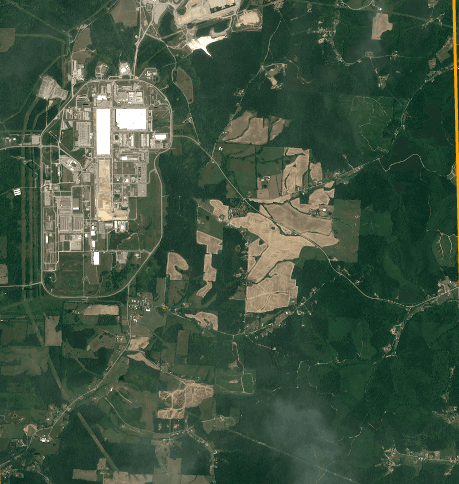
Figure: xAI - Colossus 1 construction progress as of January 13, 2026. Captured via Pléiades Neo satellite, © 2026 Airbus DS, sourced through SkyWatch. Image analysis by Aterio.
Meanwhile, the site’s early operations continued to draw regulatory attention. The U.S. Environmental Protection Agency (EPA) stated that the mobile generators used during Colossus 1’s initial activation required air permits and were operated illegally. This finding validated concerns raised by local residents and showed how rapid energy expansion at advanced facilities can test existing rules.
Overall, Colossus 1 highlights how AI data centers are reshaping energy planning. Rather than relying just on grid expansion, the supercluster combined on-site generation and battery storage to accelerate deployment. What is clear is that this project represents a shift away from traditional hyperscale designs toward AI campuses built around complex energy systems.